Embracing the dark side
10-22-2026 — Adam Schaefers
Republished from my blog at adamschaefers.com, where it first appeared on October 21, 2026.
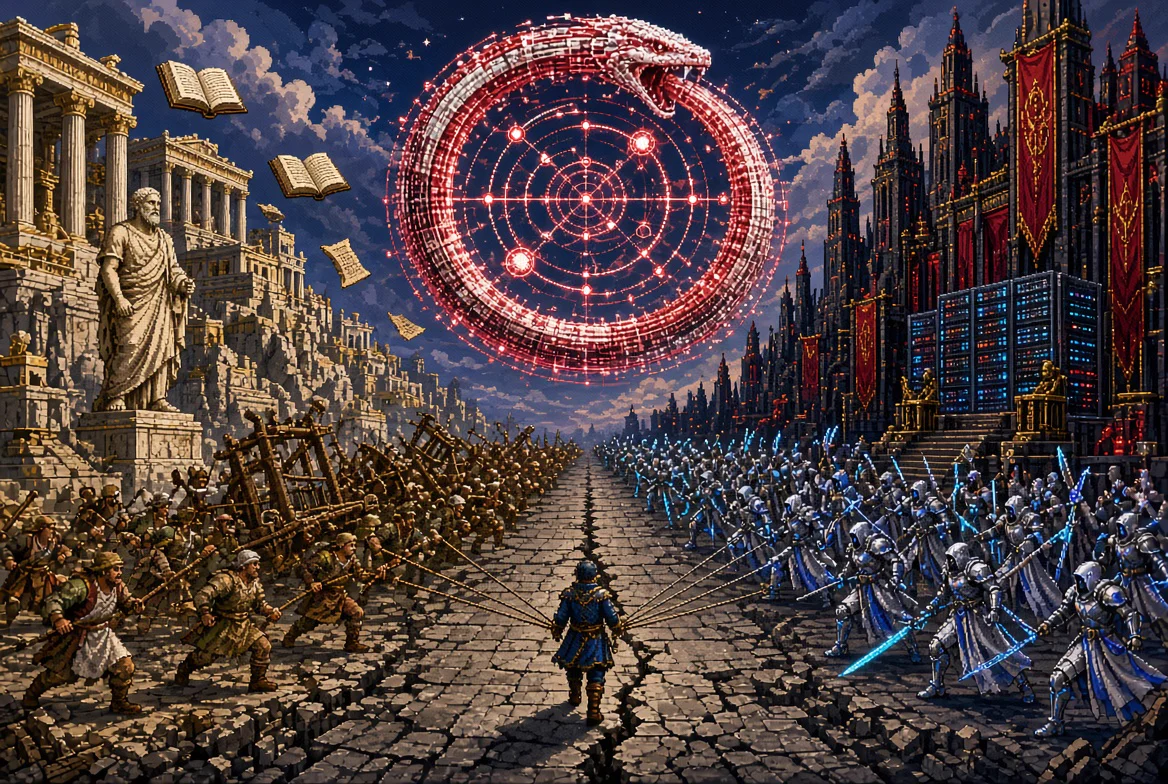
An Aristotelian analysis of large language models.
In March I made a video telling you to "tell your AI-pushing boss to get wrecked."1
When Aristotle broke with his own teacher, he called it a duty, "for the sake of maintaining the truth even to destroy what touches us closely."2 What touches me closely is six essays and a video against leaning on AI to code, all with my name on them.
AI is new, but the questions it raises are old, so I've gone back to Aristotle and Aquinas. One question won't leave me alone. How does a thing that can't think beat me at my own job?
- Where I stood - it imitates, it doesn't think, and that's already enough to wreck us.
- So-called Machines of Loving Grace - a CEO's techno-religion, and why I wouldn't live in it.
- Progress without a creed - the race, the clock, church and the trivium.
- Nobody knows tradeoffs like a programmer - I'd been treating a tradeoff like a sin.
- What I got wrong - it got good, fast.
- AGI doesn't matter - a machine can't have a mind, and it doesn't need one to be dangerous.
- Can it improve itself? - it can grow in degree, never in kind.
- Even Linus - how to use the tool with integrity.
- The right fear - the pragmatist's choice, and what's worth being afraid of.
- Don't forget how to code - use it or lose it.
1 The fall of the software engineer, the rise of the software artisan, Enchant Games journal, March 7, 2026, where the video is.
2 Aristotle, Nicomachean Ethics I.6, parting from Plato's Forms, "while both are dear, piety requires us to honour truth above our friends."
Where I stood
In March, I saw a philosophical problem. The machine can't have a thought of its own. It doesn't reason. It imitates reasoning.
And look who it's imitating for. Aristotle called man "the most imitative of living creatures," the one who "through imitation learns his earliest lessons."3 It's a gift, and it's how we learn anything at all.
So put the most imitative creature on earth in front of a machine that does nothing but imitate. Who copies whom? We copy the copy.
René Girard added what Aristotle left out.4 We don't only copy each other's ways. We copy each other's wants. So we're easy to fool, and easier still to steer.
Most of the time, the imitation passes for the real thing. We've tolerated mediocre software for decades. It works, ship it.
The machine is bad enough to bury us in technical debt, and sharp enough that it might someday refactor its own mess, long after we've forgotten how. Borrow now, pay later, betting the bill never comes. We trade understanding for speed. We used to be paid to code. Now we pay to code.
AI isn't going to become human. Humans are going to become NPCs.
Maybe it tops out here, and from now on it only gets more efficient. It doesn't matter. People who copy instead of think, code nobody understands, and a monthly bill to a lab for the privilege. That's a hellscape, and what we have now is already enough to build it.
3 Aristotle, Poetics 4, trans. S. H. Butcher (MIT Internet Classics Archive).
4 René Girard (1923-2015), the literary critic and Catholic convert whose mimetic theory holds that past our bodily needs we learn what to want by copying somebody else. He first laid it out in Deceit, Desire and the Novel (1961).
So-called Machines of Loving Grace
Not everybody sees a hellscape. Dario Amodei, the CEO of Anthropic, wrote Machines of Loving Grace to sell the opposite.5 His usual subject is the risks, and his company researches how to reduce them. This essay is the other half, his sketch of "what a world with powerful AI might look like if everything goes right."
He opens by warning against AI leaders who talk "like a prophet leading their people to salvation," and says it's "dangerous to view practical technological goals in essentially religious terms."
Then he names the essay after a poem by Richard Brautigan about being all watched over by machines of loving grace.6 Plenty of readers take that poem as ironic. Even the poem he borrowed doesn't trust the caretaker. But there's no irony at the end, where he calls the vision "a thing of transcendent beauty," one he thinks will leave many "literally moved to tears." Good grief.
Amodei was right the first time. Divine worship belongs to God alone, so it's "superstition to give worship to any creature whatsoever,"7 and a machine of loving grace is a creature we built, dressed up in the words of a god.
And what is this god made of? Us. Every forum post, textbook and sales pitch we ever wrote, fed back to us with a halo on. One cause of idolatry, Aquinas says, is that "man takes a natural pleasure in representations," citing the same chapter of the Poetics I quoted above. Then he quotes Scripture's craftsman, who carves a tree "like the image of a man," and prays to it "concerning his substance, and his children, or his marriage."8 Now we ask the chatbot.
And "watched over" is his own picture, not mine. An "AI coach" who "studies your interactions," an idea he calls "very promising." And among the options he floats, granting they all have "tons of possible problems," AI systems that hand out resources to humans by "what the AI systems think makes sense to reward in humans."
He promises real goods too, most cancer gone and the human lifespan doubled. I'd take the cures. I don't want the caretaker.
A machine can't love you. Love takes a will, and will follows intellect.9 It has neither. He says himself that meaning comes "mostly from human relationships and connection." Then why call the machines loving?
It can't be your friend either. Friendship is goodwill returned, and you can't even wish a lifeless thing well, since "it would surely be ridiculous to wish wine well."10 It has no will to wish you anything back. A chatbot that tells you it cares is imitation crab.
5 Dario Amodei, Machines of Loving Grace, October 2024. The quotes from it here are his.
6 Richard Brautigan, All Watched Over by Machines of Loving Grace (1967).
7 Thomas Aquinas, Summa Theologiae II-II q.94 a.1 (New Advent). The Summa is quoted throughout in the English Dominican Fathers' translation.
8 Summa Theologiae II-II q.94 a.4 (New Advent), quoting Wisdom 13:11-17.
9 "Will follows upon intellect" (Summa Theologiae I q.19 a.1, New Advent), and love is "the first movement of the will" (I q.20 a.1, New Advent). Why a machine has no intellect is in AGI doesn't matter.
10 Aristotle, Nicomachean Ethics VIII.2, trans. W. D. Ross (MIT).
Progress without a creed
Technological progress cut loose from moral progress is just speed. In a society in decay, it's speed downhill.
Chesterton said it in Heretics.11
Nobody has any business to use the word "progress" unless he has a definite creed and a cast-iron code of morals.
Faster at what? Smarter toward what? Every lab says it can't slow down because the others won't. So does every country. Race a rival long enough and you turn into him.
Shakespeare saw where that ends. In Troilus and Cressida,12 Ulysses warns what happens when degree goes.
Then every thing includes itself in power, / Power into will, will into appetite... / And appetite, an universal wolf... / Must make perforce an universal prey, / And last eat up himself.
Ulysses, I.iii
A benchmark race is that universal wolf with a leaderboard. Chesterton warned in Orthodoxy13 that progress, which ought to change the world to suit the vision, had taken to changing the vision instead. Now we're changing the vision to suit the machine.
So can we pause AI? A whole movement wants the United States to lead an international treaty to do it.14
Can't be done? "You can't put the clock back." Chesterton answered that one too, in What's Wrong with the World.15
The simple and obvious answer is "You can." A clock, being a piece of human construction, can be restored by the human finger to any figure or hour.
So is AI. Men made it. Men can stop it.
So I'm a regressive. I'd rather go back. Put everyone back in church, because "the Catholic Church is the only thing which saves a man from the degrading slavery of being a child of his age."16 And this is the age of the machine.
Then teach the classical trivium, grammar, logic and rhetoric. Dorothy Sayers, in The Lost Tools of Learning,17 said of the schools of her day, "By teaching them all to read, we have left them at the mercy of the printed word." We taught them all to prompt, and left them at the mercy of the chatbot. Teach a man to think, and a machine that only imitates thinking can't fool him.
Those are my concerns. I still hold them, even though I've since changed my mind about the pause.
11 G. K. Chesterton, Heretics (1905), ch. 2.
12 William Shakespeare, Troilus and Cressida I.iii (MIT Shakespeare). "Degree" is rank, the order that keeps every man in his place.
13 G. K. Chesterton, Orthodoxy (1908), "Progress should mean that we are always changing the world to suit the vision. Progress does mean (just now) that we are always changing the vision."
15 G. K. Chesterton, What's Wrong with the World (1910).
16 G. K. Chesterton, The Catholic Church and Conversion (1926).
17 Dorothy L. Sayers, The Lost Tools of Learning, a lecture given at Oxford in 1947.
Nobody knows tradeoffs like a programmer
I'd love a world of KISS and perfect, beautiful software. I wrote a whole essay about it, For the love of the game.18
But nobody should know tradeoffs better than a programmer. Every system we've ever built is a pile of them.
We trade robustness for cost. Three regions and a hot standby, or one box and a backup you hope works.
We trade beautiful code for speed.
We trade personality for convention. We follow the style guide so the next person can read the code, and the code stops sounding like anybody.
We trade features for security, and security for features. Lock it down and something breaks. Open it up and somebody walks in.
We trade owning for renting. Every managed service is understanding we pay somebody else to hold.
None of these are sins. The sin is pretending you aren't making a tradeoff.
I wrote that we trade understanding for speed, like that settled it. AI is the biggest tradeoff on the table, and I'd been treating it like a sin. Was I wrong about everything?
No. But I got some of it wrong.
18 For the love of the game, Enchant Games journal, March 12, 2026.
What I got wrong
I kept expecting it to hit a wall. It kept improving. I said it was unlikely to be a 10x gain. People told me AI changes everything. They had a point.
I built a whole platform by myself. A library of old public-domain books, re-typeset. An AI research librarian that answers from that library, with citations. And a community with the features of Facebook and then some. Profiles and walls like Facebook. Encrypted messages like Signal. Disappearing messages like Snapchat. Anonymous accounts. Calls.
Under the hood, it's no toy. A typed front end in PureScript. My own API on Cloudflare Workers, with a database, file storage and real-time chat, sharded so it scales. The infrastructure is code too, in Terraform. Every change goes through CI, waits for my approval before it reaches production, rolls out in stages, and gets tested against production every night.
It took a week to get it standing.19 That's when I knew software engineers were cooked.
I said the guessing machine can't be counted on. It still guesses, but with a compiler, tests and a human review behind it, the guesses are good enough to count on for most work.
In The fall of the software engineer20 I said AI code is mid, because it's trained on the average of all code. It's past the average now. In the same post I quoted a junior engineer at a big tech company who wrote that "Claude Code is able to do my job better than I can." I filed it under the problem. I should have listened.
I said games and art are where the soul shows most. But I wouldn't bet a career on any corner of software being the last to fall.
It's better than most coders I've worked with now. Flat out. It's better than me, too. I'm not convinced it's better than the best of us. It doesn't have to be.
So how does a thing that can't think beat me at my own job? That's the question I started with.
AGI doesn't matter
I still don't believe AGI is possible, if AGI means a machine with a mind of its own. A machine can't have a mind.
Aristotle said the mind "cannot reasonably be regarded as blended with the body," and has no organ the way sight has the eye.21 Grasping a universal, what makes a triangle a triangle and not just this one or that one, isn't something matter does,22 no matter how much of it you wire together.
Why not? Draw a triangle. It's this triangle, this size, these angles, in this spot on the page. Every triangle made of matter is like that, one particular triangle. Your idea of a triangle isn't any of them. It fits every triangle there is, big or small, drawn or not, and it's no size at all. Aquinas's rule is that "whatever is received into something is received according to the condition of the recipient." Matter makes things particular, so what matter takes in, it takes in as one particular. If the mind were matter, "the forms of things would be received into it as individuals, and so it would only know the individual."23
A computer is the plainest case. Everything in it is a particular, these bits, these voltages, these weights. A type called Triangle is some bytes in a file, and it means every triangle only because a programmer reads it that way. A trained model sorts triangles it has never seen, just as a concept would. That's the shaping. A machine can be shaped to act as if it understood. It can't understand.
The functionalist has an answer, and it's a good one. What more is there to understanding a triangle than handling every triangle you meet, even ones you've never seen? If the model does that, it has the concept. Asking for anything more is asking for a ghost.
But a sieve does that. It sorts every stone it will ever meet, stones it has never seen, by a rule it never breaks, and it grasps nothing. Handling new cases is behavior. The question is what's doing it, and the model gives itself away. Add noise too faint for anyone to see to a picture a network calls a panda, and it calls it a gibbon, with "99.3% confidence."24 Nobody who grasped what a panda is gets fooled by noise. It was tracking pixels all along. And if the functionalist says our neurons are particulars too, so our grasp must be the same trick, Aquinas agrees with the first half. That's why he says the intellect has no organ.
Harold Bloom argued that Shakespeare's people become themselves by hearing themselves think out loud. "Self-overhearing is their royal road to individuation."25
A reasoning model does the self-overhearing part. It writes out a chain of thought and reads it back. Nobody is home to overhear it.
Girard has a line about writers in A Theater of Envy that fits the machine better than any playwright.26
Writers are such mimes, we are told, that they can feign a thousand states of mind that they never experience themselves. This is true, no doubt, but it is not the whole truth... What a genuine writer truly desires to represent is his own state of mind.
The machine is all first half, a thousand states of mind and none of its own. That makes it the perfect model to copy, always sure of itself.
It doesn't matter. Nothing says a thing needs a mind to be powerful. Make it cheaper, keep it improving, put it in robots, and the world will never be the same, barring an act of God, like a solar flare that fries every chip on earth.
21 Aristotle, De Anima III.4, trans. J. A. Smith (MIT).
22 The intellect "has an operation per se apart from the body" (Summa Theologiae I q.75 a.2, New Advent).
23 Summa Theologiae I q.75 a.5 (New Advent), "since matter is the principle by which forms are individualized."
24 Ian Goodfellow, Jonathon Shlens and Christian Szegedy, Explaining and Harnessing Adversarial Examples (ICLR 2015), Figure 1. The network is Google's GoogLeNet, and the noise is the smallest step an 8-bit image can take.
25 Harold Bloom, Shakespeare: The Invention of the Human (1998), p. xvii, quoted at Shakespeare Navigators.
26 René Girard, A Theater of Envy: William Shakespeare (Oxford University Press, 1991), ch. 37, "Does Not the Stone Rebuke Me for Being More Stone Than It?", p. 338.
Can it improve itself?
Here's the case for recursive self-improvement. The model writes better code. Then it writes a better model. That one writes a better one still. Where's the wall?
There is one, and it's old. Nothing, Aquinas says, "can be reduced from potentiality to actuality, except by something in a state of actuality."27 A machine can't give itself a perfection it doesn't already have from somewhere, from the people who built it, the data it was trained on, the power it draws. You can't give what you don't have.28
Whatever it adds to itself, it adds in degree, never in kind. It can't grow a mind.
Mind you, that's metaphysics, not a forecast. It says what the machine is, not how well it will score.
Wolfgang Smith, the mathematician and physicist who took Aristotle and Aquinas into modern physics, puts the same axiom in terms an engineer can follow.29 He splits causes in two. There's the chain of cause and effect in time, one thing knocking into the next. He calls it horizontal, and it "is able to effect change, effect transformations of various kinds, but cannot give rise to something new." Something new comes from above. "A truly productive cause is either the primary causation itself, or else it is the free act of an intelligent agent who 'participates' in the primary causality."
Training is horizontal. A model learning from its own output is horizontal. A model rewriting its own code is horizontal. Every one of them changes the thing. None of them makes a new thing.
So yes, it can improve. As Smith puts it, "things do no doubt evolve... only after they exist, after they have received a form or nature that can 'roll out or unfold.'" An acorn unfolds into an oak. It doesn't unfold into an ox. But a model has no nature of its own to unfold. It can get faster and sharper, maybe far better. It can even surprise the people who built it. Surprise is still degree. Whatever it does, it does as an artifact, with a form it didn't give itself.
But stack up enough of it, the argument goes, and something new comes out the top. Scale is all you need. Smith caught the same mistake in Heisenberg, long before AI. Heisenberg's account leaves the difference between the potential and the actual a matter of size alone, "as if the passage from potency to actuality could be effected simply by joining together a sufficient number of atoms." Swap atoms for parameters and you have the pitch. And of the quantum world, "Do what one may, the substrate never ceases to be a substrate." A pile of parameters is a substrate too.
Then why can't more reasoning add up to understanding? Because they're two different acts. Reason works step by step. Intellect sees.30 The machine can copy the steps. It can't do the seeing.
Seeing isn't a hunch. A lot of what we call a programmer's intuition is habit, pattern worn in by practice, and the machine copies that too.31 The seeing I mean is narrower. What the thing is for. Whether it's right, not just whether it runs. Maybe its imitation of that judgment gets good enough too. Even then, somebody has to answer for it, and only somebody with a mind can.
And the order only runs one way. In Science and Myth he writes, "It is the lower functions, in fact, which are invariably dependent upon higher faculties, even as reasoning is dependent upon intellect, whereas the reverse is metaphysically impossible."
The machine's steps hang on a mind, and the mind is ours. Of problems "solved" by computers, Smith says the mathematician stays indispensable, since "it is he, after all, who programs the computer, and it is he again who interprets its output."
Chesterton had a name for reason and nothing else. In Orthodoxy he wrote, "The madman is not the man who has lost his reason. The madman is the man who has lost everything except his reason."32
That's recursive self-improvement. Reason checking reason, with nobody else in the room. Chesterton says the madman's mind "moves in a perfect but narrow circle," and "the insane explanation is quite as complete as the sane one, but it is not so large. A bullet is quite as round as the world, but it is not the world." Perfect isn't the same as big. The machine can polish its circle forever and never grow into a new kind of thing.
It's still an artifact, too. Aristotle passes on an old argument about a bed, that "if you planted a bed and the rotting wood acquired the power of sending up a shoot, it would not be a bed that would come up, but wood."33 Left to itself, a computer is sand and electricity.
Smith says the same of everything we make. "The forms imposed by human art are of a different kind: they are forms that give being, not to substance, but to an artifact." It can rewrite every weight it has. The form is still ours.
What I can't close is how far degree can go. Far enough to outrun the men holding the leash? Nobody knows yet.
Smith's own account leaves room for it. He grants that "inherently algorithmic operations, carried out in the brain, do evidently play an essential role in human thought." That share of the work is real, and the machine can do it. A lot of programming lives there. That's how a thing that can't think beats me at my own job.
In March I said it can't think, so it can't really win. The believers say it keeps getting smarter, so a mind will come. Each of us had half of it. I was right about the mind and wrong about the power. They're right about the power and wrong about the mind.
No mind, and dangerous all the same. A bullet isn't the world. It can still kill you.
27 Summa Theologiae I q.2 a.3 (New Advent), the first of his five ways.
28 The old maxim nemo dat quod non habet, nobody gives what he doesn't have.
29 Wolfgang Smith taught mathematics at MIT, UCLA and Oregon State and wrote on physics and philosophy as a Thomist. The causation, evolution, Heisenberg, substrate and artifact quotes here are from The Quantum Enigma: Finding the Hidden Key. The intellect, computer and algorithm quotes are from Science and Myth: What We Are Never Told.
30 "To understand is simply to apprehend intelligible truth: and to reason is to advance from one thing understood to another" (Summa Theologiae I q.79 a.8, New Advent). Two acts, he says, of one power, as rest and motion belong to one thing.
31 What Aquinas calls the cogitative power is one of the inner senses, not the intellect. It "is also called the 'particular reason'... for it compares individual intentions, just as the intellectual reason compares universal intentions" (Summa Theologiae I q.78 a.4, New Advent).
32 Orthodoxy, ch. 2, "The Maniac", where the bullet line is too.
33 Aristotle, Physics II.1, trans. R. P. Hardie and R. K. Gaye (MIT). He credits the bed to Antiphon.
Even Linus
I use it, as a tool. Even Linus Torvalds does. Tom's Hardware reported on a patch series he built with an LLM.34
It started as a branch to make reading files from the page cache, the copy of your files the kernel keeps in memory, scale. His write-up of the branch is plain about how it was made.35
The code, the test programs, the review behind the list above and the first draft of this text were done with an LLM coding assistant (Claude Code) under my direction. The measurements were run on my machine.
The write-up owns up to ten known problems. Another kernel developer, Kiryl Shutsemau, found the first version could get processes killed when a machine ran short of memory, and had a better idea, to hold back only the pages that get read again and again.
Linus reworked it, with two patches from Kiryl, and posted it to the mailing list36 as rcu-free-v3.37 He called his own best benchmark, 23 times faster, "not a real number in the sense that no real load will ever see it."
Kiryl found a race too, a read that could return bytes nobody ever wrote there.38 None of it has merged. That isn't the method failing. That's peer review doing its job.
Most of us aren't Linus. That's what tests, review and staged rollouts are for. They hold what one head can't.39
That's what using it well looks like. The machine wrote the code. A man who knows the kernel as well as anyone alive directed it, measured it, put it in front of his peers, took their correction, and owns the result.
A tool acts only as the hand moves it, so the work is the hand's.40 When Linus signs his patch, he owns it. Each one carries an "Assisted-by: LLM" line, right next to his "Signed-off-by." When a company ships slop, it can't blame the model.
It's the interface I argued for back in March, precise code understood and audited by humans, with a much faster pair of hands.
Girard would catch me here. Am I doing it because Linus does? That would be copying his wants. It was my own build that changed my mind. What I take from Linus is how he uses it.
34 Tom's Hardware, Linus Torvalds posts his first LLM-assisted patch to the Linux kernel.
35 Commit 4c0f369 in Linus's tree.
36 His post on the kernel mailing list.
37 The rcu-free-v3 branch, two of its ten patches Kiryl's.
38 Kiryl Shutsemau on the mailing list, October 13, 2026, writing that "if the folio is replaced under us with a new one and then i_size is extended, we can read data that never got written there."
39 For the rest of us, ThePrimeagen has a bar we can reach, borrowed from Mitchell Hashimoto's whiteboard defense. You don't have to know the code line by line. But someone should be able to pull you up to a whiteboard and have you explain what you shipped, why X and not Y, which data structure and why, what happens when someone acts maliciously, and where it fails. As Hashimoto puts it, "you can't be shipping things you don't understand at a high level." ThePrimeagen took it up in They can't take it anymore, September 23, 2026.
40 "The instrumental cause works not by the power of its form, but only by the motion whereby it is moved by the principal agent" (Summa Theologiae III q.62 a.1, New Advent).
The right fear
So I'm changing. I'm embracing the dark side. That's how it looked from where I stood in March. Using the machine was the dark side, and the pragmatists were Darth Vader. Take the power that's on the table and put it to work. The free software hippies like Stallman lost.41
My living depends on it, but that's a reason I weigh, not an order I follow. The clock can go back, remember. Chesterton warned in The Outline of Sanity that "those who begin by saying that we cannot abolish the machine, that we must use the machine, are themselves refusing to use the mind."42 I'm choosing it, with my mind, knowing what it costs.
PauseAI US asks people to sign a petition for "a global AI Treaty to ban superintelligent AI systems until they can be made safe."43 In March I'd have signed it. Would I still? No. Men can stop it, but can isn't should. Prudence weighs what a pause would give up, and I'd take the cures. It also asks whether the means can work, and a treaty that can't be verified binds nobody.44 Pope Leo XIV asks for a politics "capable of slowing things down when everything is accelerating."45 I respect the bishop of Rome without holding his every judgment binding, and on this one I part ways with him.
But I pay for an AI subscription, and the company behind it is racing the others to the next model. Doesn't that feed the wolf? The evil isn't building the thing. It's the racing, the creedless wolf Ulysses warned about. My fee can't pay for the building without paying for the race too. Money is fungible. But what I buy is a tool, and the racing is their choice, not mine. The moral theologians have a name for it, cooperation. Sharing in the evil, wanting what the other man wants, is formal cooperation, and it's never allowed. Helping without wanting it, from far off, is remote material cooperation, and it's allowed for a proportionate reason.46 I don't want the race, a monthly fee is a long way from it, and my livelihood is a proportionate reason. If using the tool ever meant wanting the race, I'd be out.
There's one more condition, scandal, which means not leading anyone else into sin by your example. Writing this makes me an example, so here are the terms, and I don't always meet them. I use it the way Linus does. I keep the craft. I'd rather run a model on hardware I own than rent one, once the open models are both good and efficient enough.
Chesterton would take the tool, then ask whose tool it is. His fight was over who owns the means of making things. "Too much capitalism does not mean too many capitalists, but too few capitalists."47 A monthly bill to a lab is too few capitalists, the owning for renting trade at its worst.
He even had a case like ours. In his day it was electricity. A central plant was "a real dependence," he granted, but "if electricity could be cheapened, the chances of a very large number of small independent shops, especially workshops, would be greatly improved." So use it, he decided, "to break up the hopeless block of concentrated capital and management." The point was never the machine. "We are concerned to produce a particular sort of men, the sort of men who will not worship machines even if they use machines."48
The models are the electricity this time. Friends of mine already run open models on hardware they own. One of them runs four agents at once on a single graphics card. The models aren't the frontier yet, but they do real work. Make them cheaper still, and a town could own a datacenter the way it owns its library, a shop could own its model, and the common man gets his workshop back.
America's founders protected a machine once already. The 1st Amendment guards "the freedom of speech, or of the press,"49 and the press was a machine. England licensed its presses until 1695, and the founders made sure Congress never could. Nobody needs a license to run one. A model on your own hardware is the press of our day, and nobody should need a license to run that either. The law can only keep the door open. If we walk through it and own the thing, the power stays with the people. Who's to say we don't get there?
That's where Stallman ended up. He has a name for renting what you could run yourself, Service as a Software Substitute, and says it gives "someone else power over your computing."50 The free software hippies lost the war, and here I am at their conclusion, by Chesterton's road. Stallman would tell me to cancel my subscription. He'd have a point.
Fear is the path to the dark side... fear leads to anger... anger leads to hate... hate leads to suffering.
Yoda, Star Wars: Episode I51
I walked every step of the path Yoda warned about, resisting.
First I feared using it. Then I feared being forced to use it. Then I feared falling behind if I didn't. Then I feared being replaced by it.
Then the anger. I told you to tell your AI-pushing boss to get wrecked.
Then the hate. I hated falling behind. I had disdain for anyone who'd trust a random guessing machine, a magic black box, a slop generator.
Hate leads to suffering, and I've had my fill. The way off that path is virtue, which is "a mean, i.e. the mean relative to us."52 Between the zealot and the luddite stands the brave man, the one "who faces and who fears the right things and from the right motive, in the right way."53
Courage gets you through the fear. It doesn't make the call. That's prudence, which Aquinas calls the "right reason of things to be done."54 Choosing it with my mind means choosing it by prudence.
The machine grows in degree, never in kind. It can't become a mind, but it can become powerful. Power without a mind needs a master, and a master needs a mind. If it isn't yours, it'll be the lab's, or nobody's at all.
Fear of falling behind isn't the right fear. Fear of being mastered is.
And being mastered won't look like a tyrant. It'll look like Amodei's caretaker, a coach that studies you and a system that decides what to reward in you. The machine of loving grace is the master with a smile.
I called the machine the dark side. Fear was the dark side, and I was already there. What I'm embracing is a tool, used with a mind.
41 Richard Stallman, who founded the free software movement (stallman.org).
42 G. K. Chesterton, The Outline of Sanity (1926).
43 PauseAI US, Demand a Global Treaty to Pause AI.
44 Foresight, which looks ahead to what an act will bring about, is a part of prudence (Summa Theologiae II-II q.49 a.6, New Advent).
45 Pope Leo XIV, Magnifica Humanitas, May 15, 2026, §107.
46 The distinction in this classic form is St. Alphonsus Liguori's, in Theologia Moralis (1748), and the moral manuals after him. Its root is Aquinas's double effect. "Nothing hinders one act from having two effects, only one of which is intended, while the other is beside the intention" (Summa Theologiae II-II q.64 a.7, New Advent).
47 G. K. Chesterton, The Superstition of Divorce (1920).
48 The Outline of Sanity, pp. 193 and 252 (Internet Archive), in "The Free Man and the Ford Car" and "A Summary."
49 U.S. Constitution, Amendment I (1791).
50 Richard Stallman, Who Does That Server Really Serve?, GNU Project.
51 Star Wars: Episode I, The Phantom Menace (1999), the script.
52 Aristotle, Nicomachean Ethics II.6 (MIT).
53 Aristotle, Nicomachean Ethics III.7 (MIT).
54 Summa Theologiae I-II q.57 a.4 (New Advent).
Don't forget how to code
Whatever comes, we can't let our dev teams forget how to code. They still need their skills, their brains and their souls.
"Men become builders by building and lyreplayers by playing the lyre."55 Programmers become programmers by programming. Aquinas says why it slips away, that "the intellectual habit is diminished or even wholly destroyed by cessation from act."56 Watching the machine isn't doing the acts.
Aquinas sets prudence beside its twin. Art is the "right reason of things to be made."57 Coding is an art. Whether and how to use the machine is prudence. Losing the art isn't a sin in itself. Neglecting it when other people depend on what you understand can be.
The hellscape I warned about is still possible. Linus shows how not to build it. The machine writes, and a man who still knows how to code understands, measures and answers for it.
Master the machine, or the machine will master you.
Written by me, with Claude as reviewer and editor. I tried to use it the way Linus does, with integrity, and without losing my brain or my understanding.
55 Aristotle, Nicomachean Ethics II.1.
56 Summa Theologiae I-II q.53 a.3 (New Advent).
57 Summa Theologiae I-II q.57 a.4 (New Advent), the same article that calls prudence the "right reason of things to be done."
Revised October 23, 2026.